Mobile Welding & On-Site Repair
When a machine goes down in a field off Airport Road at 4am, it does not need a shop. It needs a rig, a generator and someone who can strike an arc in the wind. That is what our truck is for.
Mobile Welding & Repair
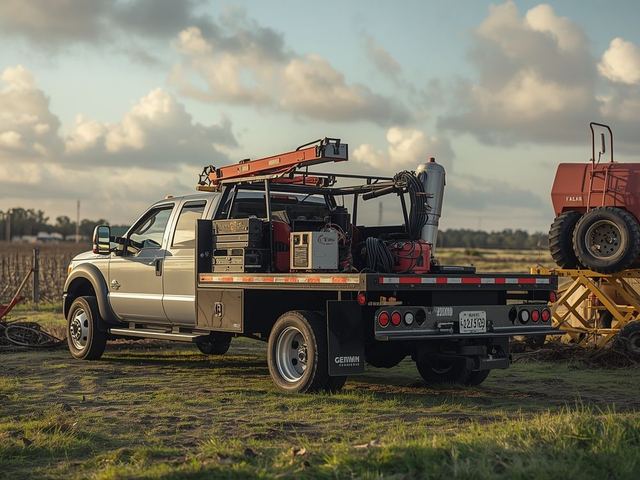
Ironwake has run a certified mobile rig since Hal bought the first Bobcat in 1994, and it has never stopped being the busiest thing we own. The truck carries an engine-driven welder, an oxy-fuel torch set, a plasma cutter, a portable mag drill, a bandsaw, and enough A36 flat bar, angle and tube to fabricate a repair on the spot rather than measuring, driving back to the shop, and returning tomorrow.
Outdoor work changes the process, and it is worth understanding why we quote it the way we do. Solid-wire MIG is the wrong tool in an open field: a five-mile-an-hour breeze will strip the shielding gas off the puddle and leave you with a porous weld that looks fine and fails in a month. So on-site we run stick, usually 7018 on clean structural steel and 6011 when we have to burn through mill scale, rust, paint or the grease that coats every piece of harvest equipment in Hillsborough County. Where we need speed and deposition on heavy sections, we switch to self-shielded flux-core, which makes its own gas shield and tolerates wind the same way stick does.
Most calls fall into a short list: cracked loader buckets and bucket-tooth adapters, backhoe sticks that have split at the boss, hydraulic cylinder mounts torn loose, snapped three-point hitch arms, broken gate hinges and fence line, dock ladders, and handrail that failed an inspection. Ag work spikes hard during strawberry season, when a broken tool bar at 6am costs a grower a full picking day, and we plan our winter dispatch around it.
We do not weld blind on someone else’s emergency. Before the hood goes down, Delia or Ruben looks at why the part failed. A bucket that cracks in the same corner twice does not need another bead in the same place; it needs a gusset that moves the stress somewhere the plate can carry it. Hardfacing on a worn cutting edge buys a season, but only if the base metal underneath is still sound. If a repair should not be trusted, we will tell you on the spot and quote the replacement instead.
| Typical response | Same day inside Plant City; 24/7 dispatch for downed equipment |
|---|---|
| Processes on the truck | SMAW (stick), FCAW-S (self-shielded flux-core), oxy-fuel, plasma |
| Common electrodes | E7018 low-hydrogen, E6011 for dirty or painted steel |
| Materials | Mild and structural steel, cast steel, some cast iron by assessment |
| Certifications | AWS D1.1 structural steel; certified mobile rig |
| Coverage | Plant City, Lakeland, Brandon and greater Tampa |
Everything this covers
No line item on this list is an upsell in disguise. If your job needs it, it is part of the work.
- Emergency dispatch for downed equipment — day, night, weekend and holidays
- Engine-drive stick and self-shielded flux-core welding, no site power required
- Oxy-fuel torch and plasma cutting for demolition and fit-up on site
- Field fabrication from stock carried on the truck — flat bar, angle, channel, square tube
- Gussets, doublers and reinforcement designed to stop a repeat failure
- Hardfacing on bucket edges, ripper teeth and wear plates
- Portable magnetic drilling and tapping for bolt-on repairs
- Gate, fence, handrail, ladder and stair repairs to code
- Cast iron and pot-metal assessment — honest advice when brazing beats welding
- Photo documentation of the repair for your maintenance or insurance file
Straight answers
How fast can you get a rig to a downed machine?
Inside Plant City we are usually rolling within the hour during shop hours and typically on site inside two hours after hours. Lakeland and Brandon add roughly twenty to thirty minutes of drive time depending on I-4.
Call rather than email if something is stopped. The mobile line is dispatched 24/7 specifically for equipment that is blocking work; the quote form is checked during business hours.
Why do you use stick outside instead of MIG?
Solid-wire MIG relies on a shielding gas curtain over the weld puddle, and even a light breeze blows it away. The result is a porous weld that can look acceptable and then fail under load.
Stick and self-shielded flux-core carry their own shielding in the electrode or wire, so they hold up in wind, and stick in particular handles the rust, scale and paint that field equipment is covered in. We bring MIG for shop-clean work and enclosed spaces.
Can you weld a repair that has already been welded badly?
Usually, but the old weld comes out first. We grind or gouge back to sound base metal, look at why the original repair failed, and rebuild it with proper joint preparation instead of stacking another bead on top of a cracked one.
If the part has been repaired so many times that the base metal is undersized or heat-damaged, we will say so and price a replacement section rather than sell you another repair that will not hold.