Aluminum & Marine Welding
Aluminum punishes people who treat it like steel. It melts at 1,220°F, but the oxide skin on top of it melts at roughly 3,700°F — so the metal underneath goes liquid before the skin ever moves.
Aluminum & Marine Welding
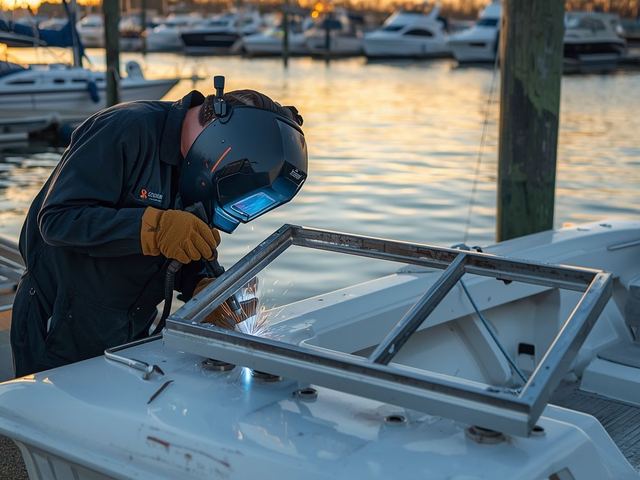
That oxide layer is the entire reason aluminum has its own certification, its own machines and its own price. On thin material we run AC TIG, and we tune the balance control so that part of every cycle is spent blasting the oxide off the joint ahead of the puddle. Get the balance wrong and you either leave dirty oxide inclusions in the weld or you cook the tungsten and drop it in the puddle. There is no way to bluff this with a steel machine.
On thicker plate — 5052 and 5086 hull material, 6061 structural extrusion — TIG is too slow and too hot, and we move to MIG with a push-pull gun or a spool gun. Aluminum wire is soft enough that a standard MIG liner turns it into a bird’s nest three feet before it reaches the arc; a push-pull system drives the wire from both ends and keeps feed steady enough to hold a clean, consistent bead across a long seam.
Filler selection matters more than most owners realise. We run 5356 on most marine work: it is stronger, holds up better in saltwater service, and colour-matches far better if the part is going to be anodized. We move to 4043 on castings and on joints where crack sensitivity is the bigger risk, since it flows better and is more forgiving on repairs to unknown alloys. Ask us which one went into your part and we will tell you why.
The failure we see most on Tampa Bay boats is not a bad weld at all — it is galvanic corrosion. Put a stainless fastener through an aluminum T-top leg, add salt spray as the electrolyte, and the aluminum becomes the sacrificial anode and quietly eats itself away around the bolt. We isolate every dissimilar-metal joint we build with nylon or Delrin isolating washers and an anti-seize barrier compound, and when we repair someone else’s work, that is the first thing we look for.
One hard rule: we do not weld a fuel tank that has not been properly purged and certified safe, no exceptions and no same-day heroics. A tank that has held gasoline holds vapour long after it looks empty, and vapour is what explodes. Bring us the tank or let us arrange the purge, and we will do it right.
| Certification | AWS D1.2 structural welding code — aluminum |
|---|---|
| Processes | AC GTAW (TIG) with balance control; GMAW with push-pull and spool gun |
| Alloys | 5052, 5086, 6061, 6063; cast alloys by assessment |
| Fillers | ER5356 for marine strength and anodizing match; ER4043 for castings |
| Also welded | 304/316 stainless, mild steel, chrome-moly by arrangement |
| Turnaround | Bench work typically 2–5 days; full T-top builds 2–4 weeks |
Everything this covers
No line item on this list is an upsell in disguise. If your job needs it, it is part of the work.
- T-tops, hardtops, leaning posts and rocket launcher racks
- Bow rails, grab rails, ladder repairs and stanchion rebuilds
- Poling platforms, casting decks and tower repair
- Transom brackets, jack plates and engine bracket reinforcement
- Pontoon toon repair, log patching and cross-channel welding
- Aluminum fuel and water tank repair — purged and certified before any arc is struck
- Aluminum boat trailer frames, bunks and guide posts
- Dissimilar-metal isolation to stop galvanic corrosion at stainless fasteners
- Custom brackets, mounts, hatches and marine hardware fabrication
- Distortion control and post-weld straightening on thin hull plate
Straight answers
Why does aluminum welding cost more than steel?
Different machine, different certification, and far more preparation time. AC TIG equipment and push-pull feeders cost several times what a steel MIG setup does, and D1.2 aluminum certification is separate from the D1.1 structural steel qualification.
The prep is the real driver. Aluminum has to be mechanically cleaned and solvent-wiped immediately before welding, with a dedicated stainless brush that has never touched steel, because any contamination ends up in the weld. That work happens whether the joint is two inches or two feet.
My T-top is corroding around the bolts. Is the weld bad?
Usually not. What you are almost certainly seeing is galvanic corrosion. When stainless fasteners contact aluminum and saltwater bridges them, the two metals form a battery and the aluminum corrodes as the sacrificial side of it.
The fix is isolation, not more welding: nylon or Delrin washers and sleeves, a barrier compound at the interface, and replacing any aluminum that has already been eaten thin. We rebuild the joint so it does not come back.
Can you weld my aluminum fuel tank?
Only after it has been properly purged and certified gas-free. An “empty” tank still holds fuel vapour in the seams and baffles, and vapour is what ignites. We will not put an arc near one on a promise that it was drained.
Bring the tank to the shop and we will walk you through the purge process or arrange it. Once it is certified safe, tank repair is straightforward work and we do a lot of it.